
August 24, 2026: Study finds black market retatrutide is not as effective as the clinical trial versions
Major Stories
A study by a Massachusetts-based data analytics company found that people taking Eli Lilly’s experimental weight loss drug, retatrutide, outside of clinical trials lost significantly less weight than patients participating in the trials. Black market users lost an average of 4.7%, 5.3%, and 7.2% of their weight after taking “reta” for three months, six months, and one year, respectively. Those in clinical trials lost an average of 5.7%, 11.9%, and 15.5% over the same time intervals. Read the study here.
Patients who leave the secure supply chain risk taking drugs that are not the strength they claim to be or taking drugs that have entirely different active ingredients. Third-party peptide vendors often import drugs from facilities that could be inadequate for sterile drug production, some of whom have faked their certificates of analysis. Of the 378 subjects taking these black market drugs, 57% got the drug from online or telehealth vendors, 29% from compounding pharmacies, and 9% from wellness, weight loss, or other clinics. Peer review of the study is ongoing. To learn more about the landscape of black market retatrutide, visit our blog.
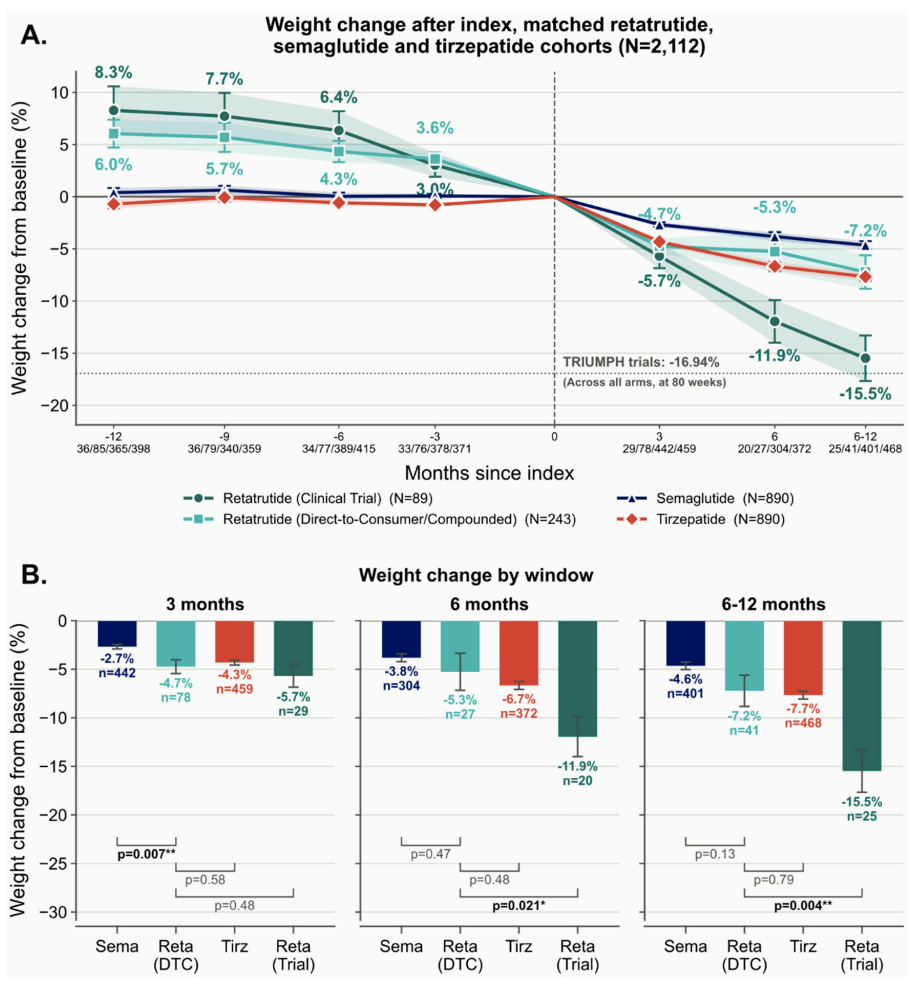
Mean percent weight change from baseline. (Source: Accelerating Use of Unapproved Retatrutide Is Associated with Weaker Weight Loss and Increased Cardiovascular Symptoms)
Peptides in the news
Recalled compounded peptide injections. Men’s Journal highlights risks of serious injectable drugs. Letter to HHS Inspector General to consider peptide panelists' conflicts of interest.
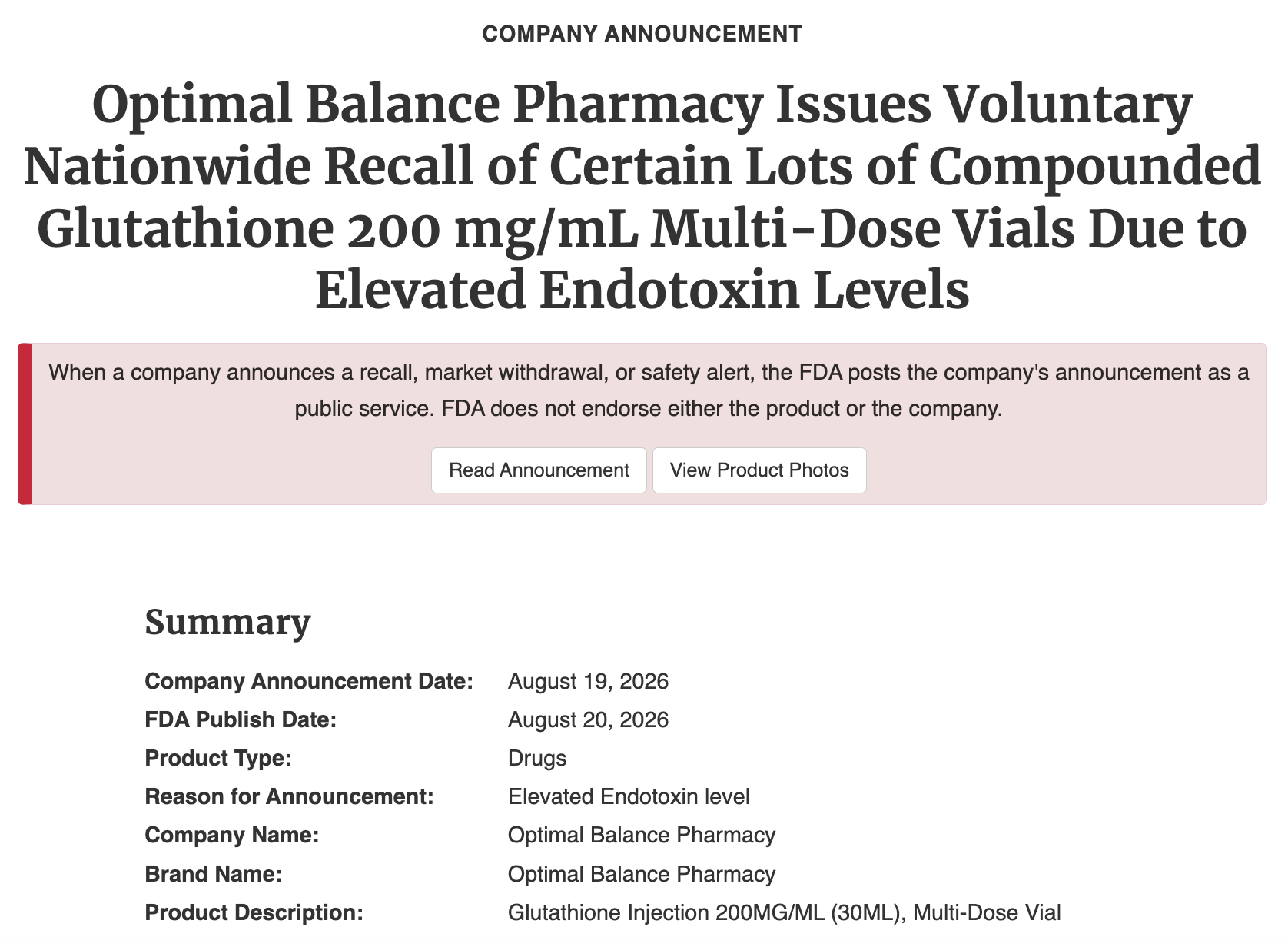
Optimal Balance Pharmacy in Houston, Texas, is recalling a lot of compounded glutathione vials for elevated endotoxin levels. Optimal Balance Pharmacy has received reports of adverse events consistent with allergic reactions. The pharmacy says the lot was distributed to customers in 14 states, and they are notifying its prescribers and patients. This follows a similar recall from Victory Medical Center Pharmacy in Austin, Texas, for compounded glutathione for elevated endotoxin levels.
Both pharmacies are registered 503A’s that advertise peptide compounding, but it isn’t clear whether these products meet the legal criteria for compounding to begin with. Glutathione is not on the FDA 503A or 503B bulks list and has a dietary supplement monograph rather than a pharmaceutical one. After another endotoxin outbreak in 2019, the FDA warned a compounder not to use a dietary supplement API in glutathione injections, which are required to be sterile.
The adverse events reported in these cases demonstrate the importance of understanding the risks of taking these drugs. Men’s Journal wrote about the number of men who casually treat peptide and steroid use, as “gym talk,” despite the serious consequences for those taking them. The outlet warned that while these unapproved, often understudied, drugs may yield the results bodybuilders are looking for in the short term, long-term consequences may be lurking around the corner.
In the aftermath of the FDA’s panel to reconsider several peptides for inclusion on the bulks compounding list, the Campaign Legal Center urged the HHS Inspector General to investigate panelists' conflicts of interest. In their letter, the watchdog group wrote that several members “appear to have had disqualifying financial interests,” and that at least seven of the twelve members had financial interests in the peptide and pharmaceutical industries. The panel is set to consider several more peptides in February 2027.

This comes as the South Carolina Board of Medical Examiners warns physicians in the state that research-grade, non-FDA-approved peptides should not be recommended or prescribed.
Domestic
An Indian morphine pill importation scheme in New York. NY state warns against online pharmacies. Colorado PDAB reignites concern over patient access restrictions.
A Canadian man was convicted of conspiracy to possess with intent to distribute morphine for his role in a scheme that imported Indian morphine pills to New York for distribution in Canada. The man coordinated bulk pill shipments to multiple individuals in New York, who would store the drugs while waiting for a truck driver to pick them up and take them across the border. He is awaiting sentencing.
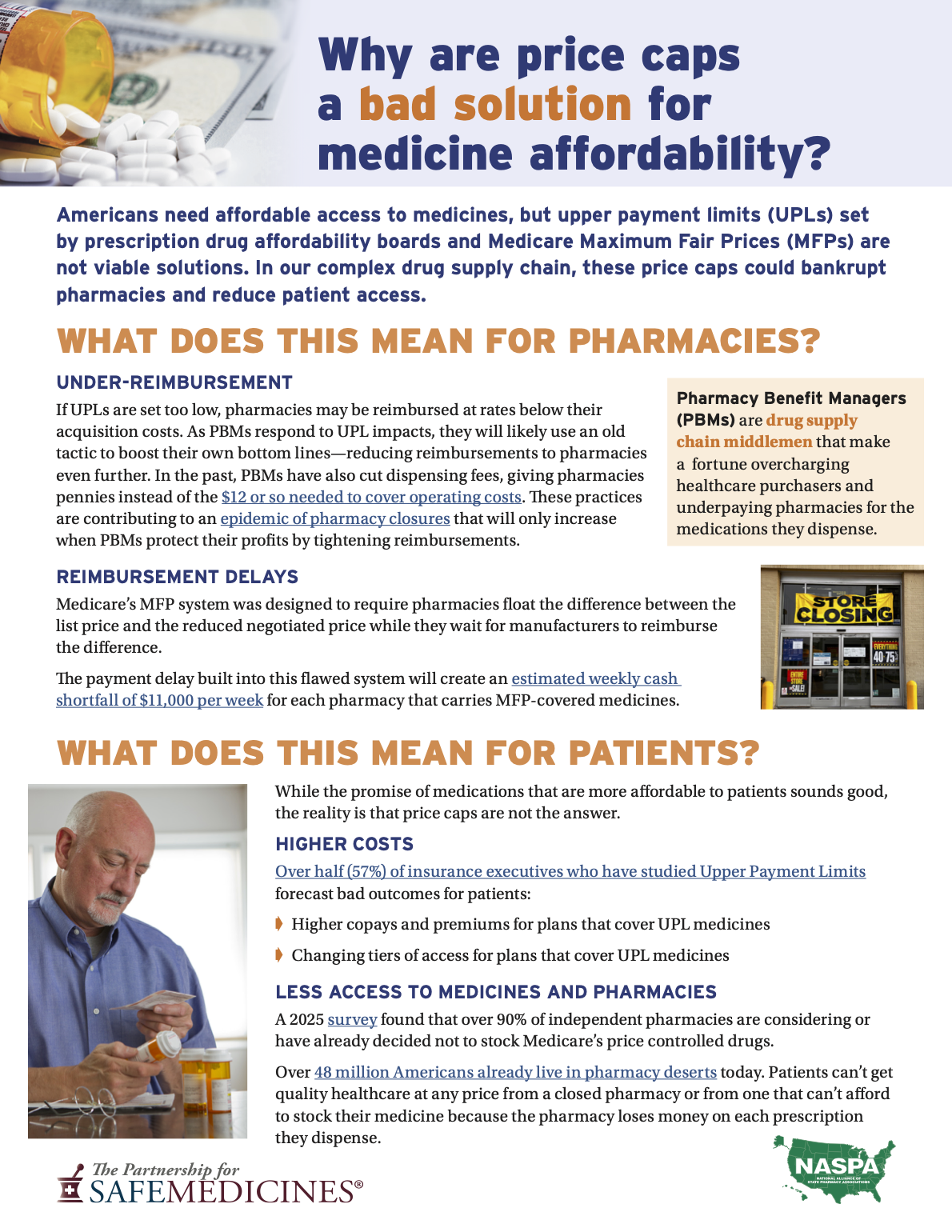
Learn why price caps are a bad solution for lowering drug costs here.
The New York Division of Consumer Protection warned consumers that some online pharmacies operate illegally and may sell counterfeit, improperly compounded, or substandard medicines. The report lists warning signs for unsafe online pharmacies, including dispensing prescription medicines without a prescription, listing unusually low prices, and offering no access to a pharmacist.
In the ongoing legal battle over Colorado’s Enbrel price cap, state attorneys argued Amgen failed to prove the upper payment limit would cause harm to the manufacturer. The Value of Care Coalition criticized this stance as highlighting the policy's uncertainty regarding who in the supply chain will bear the cost. Patient safety groups have long warned that price caps could lead to pharmacy underreimbursements, potentially causing closures and reducing patient access to life-saving medications.
First World Pharma reported on a patient who suffered a non-fatal overdose from a previously undocumented synthetic opioid, cychlorphine. The patient reported taking alprazolam, leading to concerns that a counterfeit pill may be the culprit behind the exposure. Routine testing didn’t detect the opioid, but naloxone was effective, highlighting the importance of the availability of the treatment.
National Fentanyl Prevention and Awareness Day
Families who have lost loved ones to fentanyl continued to turn their grief into action as communities marked National Fentanyl Prevention and Awareness Day on August 21. PSM published the story of Tyreek Lewis, a Philadelphia truck driver who took what he believed was a prescription painkiller for severe back pain. The pill was counterfeit and laced with fentanyl. Tyreek died, leaving behind four children, a fiancée, parents, and siblings. His mother, Antoinette Hornsby, has since dedicated herself to fentanyl prevention, saying, “I lost my child, but I'm out here fighting for yours.”
The Drug Enforcement Administration (DEA) honored two Pacific Northwest mothers, Sandy Snodgrass and Laura Lynch, with Fentanyl Free America Prevention Awards for turning their loss into prevention and education efforts. Snodgrass founded Alaska Fentanyl Response after her son Bruce died from fentanyl poisoning and has helped bring “One Pill Can Kill” presentations to more than 20,000 students. Lynch, whose daughter Brillion died from fentanyl poisoning, has worked with DEA Seattle to reach more than 30,000 students across Western Washington.
Amy Neville, who lost her son Alexander to a counterfeit drug bought on Snapchat, was interviewed by The Sydney Morning Herald about her advocacy for reform on social media platforms.
Advocates like Hornsby, Snodgrass, Lynch, Neville, and PSM board member Andrea Thomas want Americans to know that fentanyl poisoning can even happen to people who never intended to use fentanyl. Thomas, who lost her daughter Ashley to a counterfeit pill, helped establish National Fentanyl Prevention and Awareness Day and continues to warn that people can unknowingly take a lethal dose. DEA officials likewise emphasize that illicit pills are unregulated and can vary dramatically in potency, even within the same batch.

Pill presses
The DEA’s Detroit Field Division announced that a recent enforcement surge resulted in the seizure of at least one pill press and drug-packaging materials and 17 kilograms of fentanyl, which they say could lead to 8.5 million potentially deadly doses.
PSM in the news
In their commentary on the FDA’s peptide advisory council meeting, the Public Health Policy Journal highlighted concerns about the potential expansion of compounded peptide use, particularly injectable products. The piece notes that the Partnership for Safe Medicines, along with Public Citizen, raised concerns that adding peptides to the 503A bulk drug substances list could effectively create an “uncontrolled human trial” without the clinical evidence and adverse-event reporting requirements that accompany FDA-approved drugs. The author argues for large clinical trials and safety registries to better understand the risks of these products, particularly when they are administered by injection.
PSM in the news
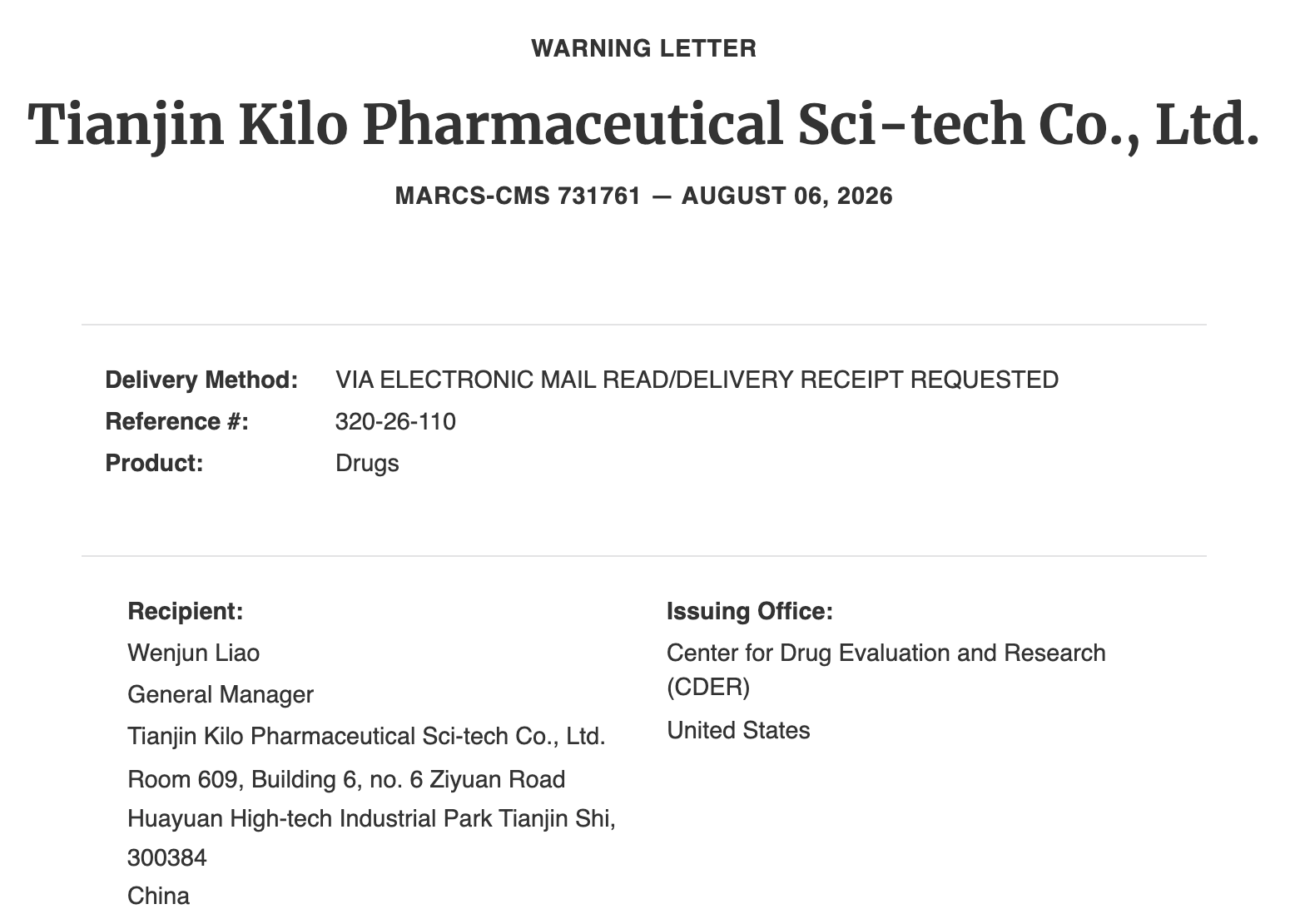
The FDA found significant CGMP deviations in APIs made by a Chinese manufacturer, including those sent to American 503A compounding pharmacies. The company failed to maintain complete master production and control records and failed to list multiple products it was manufacturing and shipping to the U.S. under its own labeler code. FDA placed the firm’s drugs and drug products on Import Alert 66-40 in July.
The FDA also found serious deficiencies in a California facility’s sterile manufacturing operations, including poor aseptic practices that could compromise sterility and poor controls for detecting particulate contamination in finished products. FDA noted that similar serious violations had been cited in a 2023 warning letter, and that the company had initiated a recall of commercial products manufactured during the period associated with failing media fills.
Finally, the agency cited an Arizona manufacturer for not adequately identity-testing incoming components and lacking validated microbiological testing methods for every batch of OTC drugs before release. The FDA also found that the company failed to investigate repeated out-of-limit microbial results from a water system used in manufacturing and released products made with that water to market.
International
Australian regulators find peptides vary significantly in strength and may cause liver failure. UK reporters highlight easy access to unapproved drugs. Health Canada seizes unapproved drugs.
Australia’s drug regulator, the Therapeutic Goods Administration (TGA), issued a new warning about a popular nasal spray that claims to give people a shortcut to a darker tan, after tests revealed wildly different strengths of the drug. The TGA tested five bottles of a peptide that claimed to be 30 mg, finding that the estimated amount ranged from 22 mgs to 54 mgs. While the peptide is widely known for its tanning properties, the Cancer Council of Australia says that several cases of abnormal moles and melanoma have been associated with it.
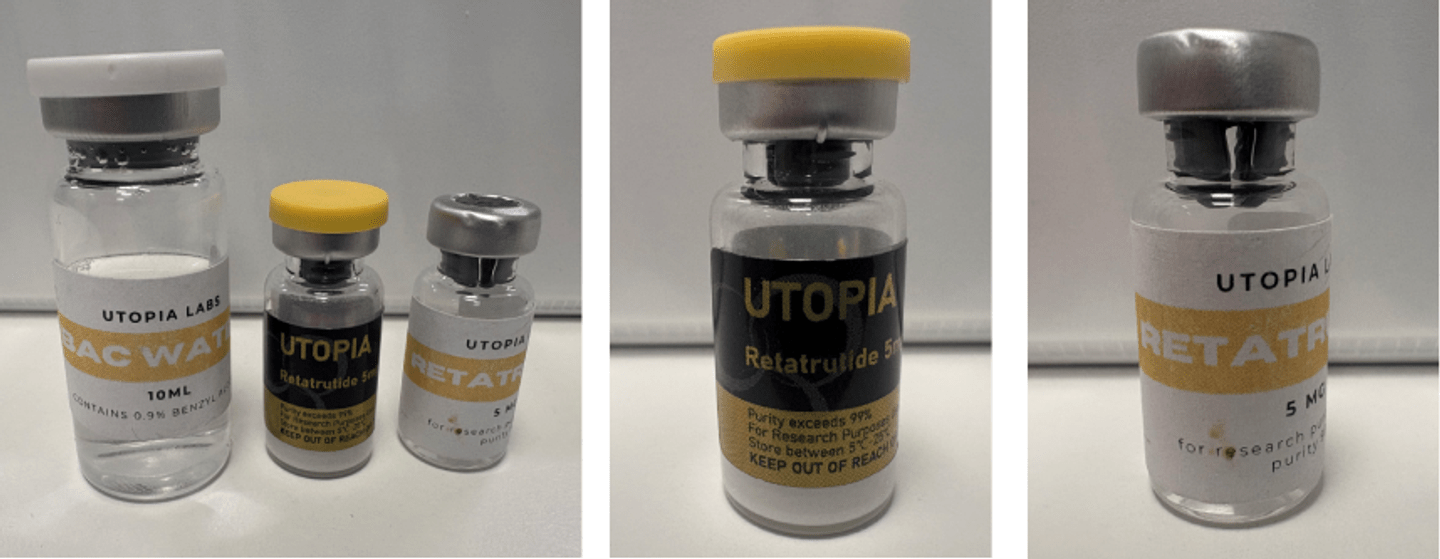
Examples of products linked to liver toxicity (Photo: Victoria, Australia Department of Health)
This comes as a seventh Australian patient is reported to have suffered from acute liver failure after receiving a black-market retatrutide injection. The TGA speculated that the localized nature of the liver failure cases may indicate a “batch problem," though there is not yet testing to support that conjecture. The agency warned that patients should opt for brand-name versions of weight loss drugs, rather than unapproved peptides.
Reporters in the UK investigated ease of access to retatrutide, obtaining a five-week supply from an “entrepreneur” for £55. The businesswoman reported that she imported the “research use only” drug from China, but reporters could not find evidence of her suppliers or their website.
Health Canada seized unapproved antibiotics, antiparasitics, erectile dysfunction, and emergency contraceptives at a Montreal corner store. The agency warned that the products may pose serious risks. To avoid these drugs, Health Canada urges consumers to buy medicines through a licensed pharmacy.
Indian police arrested 17 people, including four employees of leading cancer hospitals, for their roles in a scheme to sell counterfeit and diverted oncology drugs, including the blockbuster cancer drug Keytruda. Police say the counterfeiter stole drugs, vials, and packaging material from private hospitals to repackage counterfeit versions of expensive, high-demand medications.
Korean drugmakers cracked down on imported copycat aesthetic medicines. The rise of K-beauty has led to the popularity of the devices, including Botox and fillers, which have been the subject of multiple counterfeiting schemes.
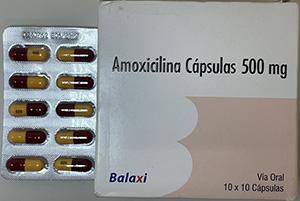
Unapproved drugs claiming to contain amoxicillin. (Photo: Health Canada)