
Tens of thousands of units of retatrutide: May & June 2026 freight fraud
The market for peptides and next-generation weight-loss drugs continues to expand rapidly, and our latest review of pharmaceutical import data shows that questionable products and unverified manufacturers remain present in the U.S. supply chain. In recent freight fraud reports, we have documented how illicit suppliers have adapted to increased scrutiny of semaglutide and tirzepatide imports by changing product descriptions, using alternative customs classifications, and shifting toward newer compounds.
For this analysis of May and June 2026 data, PSM reviewed 167 peptide shipments and 1,792 shipments associated with antidiabetics, semaglutide, and tirzepatide using FDA import records, ITACS manifest data, FDA registration databases, and product classifications. We examined manufacturer names, addresses, shipment descriptions, and declared product categories to identify shipments associated with facilities that did not appear consistent with legitimate pharmaceutical manufacturing activity.
Read more:
Fishy Peptide Freight: What Q1 2026 import data reveals (PSM report)
Knockoff weight loss drugs from illegal foreign sources (PSM report, March 2025)
Review previous updates on our pharmaceutical border security page

Among peptide shipments reviewed, 23% originated from facilities identified as illegitimate manufacturers, while only 4% total were refused entry. Among antidiabetic, semaglutide, and tirzepatide shipments, 12% originated from illegitimate facilities and only 1.5% were refused. These findings reflect a continuing challenge at the pharmaceutical border: detecting and stopping potentially unsafe, unauthorized products before they enter the U.S. medicine supply.
PCAC peptides in the spotlight
In July 2026, the FDA’s Pharmaceutical Compounding Advisory Committee (PCAC) voted to recommend adding six of seven peptides to the 503A Bulk Drug Substance List, despite FDA scientists recommending against adding all seven. The compounds considered included BPC-157, KPV, TB-500, MOTs-C, Emideltide, Semax, and Epitalon. Another meeting is scheduled for February 2027 to consider GHK-Cu, Dihexa acetate, and Melanotan II, among other peptides.
While the vote was advisory and does not itself authorize widespread use, PSM Executive Director Shabbir Imber Safdar has warned that the committee’s recommendation could create confusion among patients who may interpret the vote as FDA approval or an endorsement of these products.
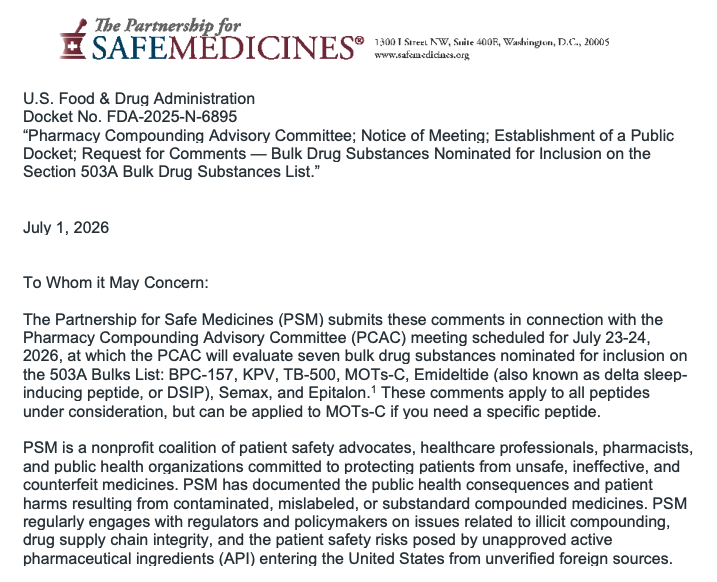
Read PSM's comments submitted to the FDA for consideration before the PCAC meetings.

Danish shopping center that contains a bookstore/post office which is listed as a peptide manufacturer.
Our import data shows why these concerns matter. We identified 17 shipments involving PCAC peptides, representing approximately 10% of all peptide shipments reviewed. These included BPC-157, GHK-Cu, MOTs-C, Semax, and TB-500.
Despite all of these chemicals being unregistered and clearly listed on the manifest, none were refused.
Six shipments were identified as intended for compounding, and eight came from facilities identified as illegitimate manufacturers (including one shipment intended for compounding).
Several shipments from unapproved manufacturers raised serious questions about the legitimacy of the supply chain:
- Four shipments came from entities identified as “retalabs,” with one listed address tracing back to a bookstore and postal offices in the Netherlands.
- Two shipments listed an address associated with a Shoppers Drug Mart location.
These findings underscore why expanding access to peptides without first ensuring a secure and transparent supply chain presents significant risks. A committee recommendation to consider these substances for compounding should not be interpreted as evidence that these products are FDA-approved, proven safe, or equivalent to approved medicines. For patients and providers, that distinction matters.

"Manufacturer" of two peptide shipments from Canada.
Retatrutide: hard to ignore
Retatrutide represents one of the clearest examples of how demand for future weight-loss medicines is outpacing the regulatory process. The drug is still in clinical trials with Eli Lilly and has not been approved by the FDA. There is currently no legitimate commercial supply chain for patients to obtain retatrutide. Any retatrutide being sold outside authorized clinical trials is coming from the black market.
Our analysis identified eight retatrutide shipments entering through the pharmaceutical import pipeline. One shipment alone declared 222,930 pieces.

The scale of these shipments demonstrates the growing demand for compounds before they have completed the FDA approval process. This trend has already produced patient safety concerns.
Recent reporting from CBS News documented extensive patient harm associated with chemicals claiming to be this unapproved weight-loss drug, highlighting the risks patients face when they obtain products outside the approved medical system.
When patients use investigational drugs from unknown sources, they lose the safeguards that accompany FDA-approved medicines, including verified manufacturing standards, consistent dosing, quality testing, and established safety information.
Read our blog, "The retatrutide black market: Patient safety groups warn of growing risks from understudied drugs"
A broader peptide problem
PCAC peptides and retatrutide are not the only drugs raising concerns. Our analysis found that 23% of peptide shipments came from illegitimate facilities, while only 4% of all peptide shipments were refused entry. In total, 34 shipments were investigational or unapproved drugs, including VRB-101, NAD, collagen, and sermorelin.
The risks associated with these products go far beyond whether they have received FDA approval. Many peptides being promoted online or through wellness channels have not undergone the clinical testing required to determine whether they are safe, effective, or appropriate for patients.
Without adequate evidence, patients may not know whether a compound works, what dose is appropriate, what side effects to expect, or how it may interact with other medications or medical conditions.

The manufacturing process creates additional concerns. Many peptides are marketed as injectable products, which means poor manufacturing practices can introduce risks, including bacterial contamination, impurities, sterility failures, or incorrect concentrations. The growing demand for peptides also creates opportunities for criminal suppliers to sell products that are mislabeled, contaminated, or contain something different from what is advertised. These products illustrate a broader trend: more compounds are entering commercial channels before regulators, clinicians, and patients have enough information to understand their safety and quality. Read more about five risks of unapproved peptides in our blog.
“Custom peptides” create unacceptable uncertainty
One of the biggest challenges identified in the review was the use of vague shipment descriptions. Of the 167 peptide shipments reviewed, 74 were labeled simply as “peptide” or “custom peptide” in ITACS.
These descriptions provide little information about what is actually being imported, who manufactured it, or whether the product is intended for legitimate research purposes or human use. The FDA should detain these shipments for further inspection to verify the contents of the package.
For the first time in over a year, we are modifying our recommendations: Shipments that do not provide adequate information should receive additional scrutiny or be rejected. A vague customs declaration should not be enough to allow potentially risky pharmaceutical products into the U.S. supply chain, and Customs should not bear the burden of guessing the nature of the substance you are shipping.

How enforcement can intervene
The latest data demonstrates the continued evolution of pharmaceutical freight fraud. When regulators increase scrutiny of one category of products, suppliers shift toward different compounds, different classifications, or vague descriptions designed to avoid detection.
Addressing this challenge will require stronger import oversight, including increased scrutiny of shipments from facilities that cannot be verified as legitimate pharmaceutical manufacturers, greater transparency from manufacturers about peptide and investigational drug shipments, and targeted review of products entering under vague descriptions such as “custom peptides.”
Regulators should also continue monitoring manufacturers associated with investigational drugs and compounds marketed outside approved pathways while ensuring import records accurately reflect what products are entering the country and who manufactured them.
What’s next?
The rapid growth of peptide markets demonstrates how quickly demand for new therapies can move ahead of regulatory safeguards.
The challenge is not limited to counterfeit medicines. Increasingly, patients are encountering real chemical compounds manufactured, marketed, or distributed outside the systems designed to protect them.
The FDA approval process exists to ensure that medicines demonstrate safety, effectiveness, quality, and consistency before they reach patients.
As new peptides and weight-loss compounds continue to capture public attention, regulators must ensure that excitement over the next breakthrough does not create a pathway for unsafe products to reach patients first.
To support this mission, PSM recommends the following policies:
Short term:
- Required inspection of shipments with an invalid FEI number.
- Continued monitoring and inspections of green list facilities to ensure FDA standards are met.
Medium term:
- FDA should be given the authority to mandate the destruction of violative shipments whose manifest states they were made in non-FDA-registered facilities. Shippers should pay the cost of destruction and present proof of destruction to the FDA.
- FDA and CBP should refuse or detain shipments of medical products whose manifest claims that they were manufactured at a site that is not a registered FDA facility.
Long term:
- CBP should be allowed to process, refuse, detain, and mandate the destruction of shipments that cannot be released because they violate the Food, Drug, and Cosmetic Act. Currently, they can only act on trademark violations and controlled substance violations (through an MOU with the Drug Enforcement Administration). Adding their manpower to the FDA’s will keep Americans safer.
Access to our data
PSM makes our shipment-level data available to a group of manufacturer brand protection teams, law enforcement, and regulators.