
PSM files Citizen Petition with FDA to stop unsafe compounding of untested peptides
October 21, 2026
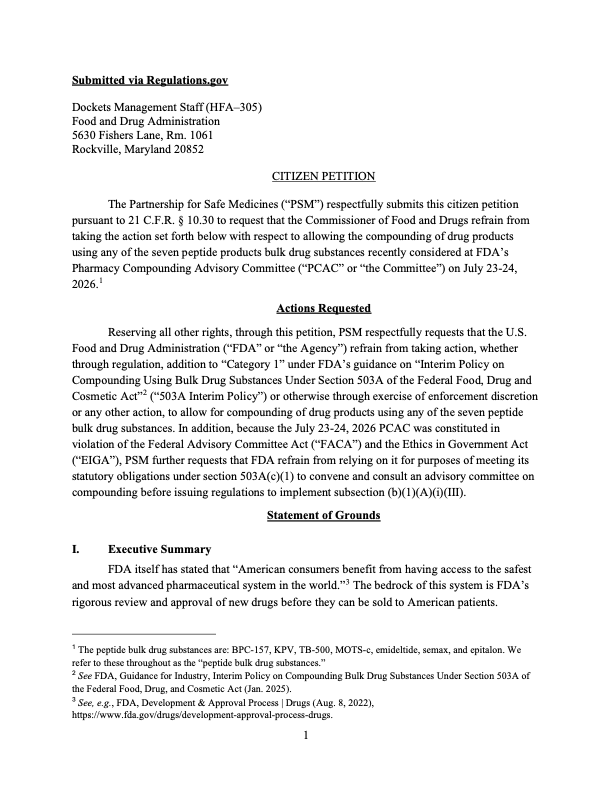
On Friday October 16th, the Partnership for Safe Medicines filed a citizen petition (CP) with the FDA asking them to refrain from taking action, whether through regulation, addition to “Category 1” of the Interim Bulk Compounding policy, or exercise of enforcement discretion to allow for compounding of drug products using seven peptide bulk drug substances (BPC-157, KPV, TB-500, MOTS-c, emideltide, semax, and epitalon).
The CP explains why it’s inappropriate to make these untested and poorly defined substances available to the public, particularly given inadequate enforcement of the current rules around compounding.
Briefing documents submitted by FDA scientists to the agency’s Pharmacy Compounding Advisory Committee (PCAC) in July state that none of these substances have been adequately tested in human trials. As the Alliance for Pharmacy Compounding pointed out in September 2026, it isn’t currently legal for 503A pharmacies to compound them. Still, licensed pharmacies across the country are selling them to patients in violation of section 503A of the Food Drug and Cosmetic Act (FDCA).
To demonstrate the practical consequences of inadequate enforcement, PSM purchased several of these peptides. Four different pharmacies in Texas and Pennsylvania compounded, dispensed, and shipped them to California in the last 45 days. The examples in the photos below are not the only examples of 503A compounding pharmacies ignoring patient safety rules. We believe FDA’s lack of enforcement of compounding limitations has created a lawless environment that threatens U.S. patients.
- CBS News has documented licensed compounding pharmacies dispensing retatrutide illegally. Recently, the FDA received reports of two patients who died after taking illegally compounded retatrutide.
- The state of California sent a cease and desist to a Texas compounding pharmacy for illegally shipping a quarter million prescriptions to California patients over ten months.
- The FDA warned several compounders and one ingredient reseller for using or distributing ingredients from non-FDA-registered sources, including Darmerica, Belmar Pharma, Pharmacy Solutions, Staska Pharmaceuticals, and ProRX.
- The agency also warned an enormous compounding pharmacy in Texas for violating, at scale, many of the regulatory limitations on 503A compounding, including prescriptions that didn’t contain sufficient medical justification for compounding and copy-cat prescriptions that appeared to have been pre-generated across thousands of patient records.
These aren’t unlicensed, bathtub compounders; they hold licenses from their state boards of pharmacy. For all the reasons listed in our citizen petition, these substances aren’t safe to compound for patients. As shown below, some licensed compounding pharmacies are making and dispensing compounded peptides that weren’t being reviewed for suitability at the July PCAC meeting at all.
The FDA’s lack of enforcement has empowered the compounding industry’s worst members to openly operate out of compliance. Compounding scofflaws have eagerly leapt into this market, and we are all in danger because of it.
Examples of licensed compounding pharmacies distributing compounded peptides in violation of the FDCA
PSM purchased these five peptide vials in the last 45 days. It wasn’t hard to find them. We simply googled the substance and found telehealth vendors willing to sell them to us in the first two pages of results.
For each, a telehealth provider facilitated a prescription from a licensed physician. We are not certain whether a physician can meet standard of care obligations in most states when they are writing a prescription for an unapproved substance with insufficient human trial data. But the prescription was obtained, and then in each case medicine was compounded, dispensed, and shipped to California. We were unable to find California licenses for three of the four supplying pharmacies; a fourth does not seem to have the sterile compounding license required to dispense sterile compounded injectables. The offending pharmacies are licensed in their own states, Texas and Pennsylvania.
No license, in any state, allows a compounding pharmacy to make and dispense these products to patients because federal law prohibits their compounding for human use. And they are meant for human use; none of them are labeled “research use only” and all were shipped with syringes and injection instructions. In one case, there is a diagram of a human body.
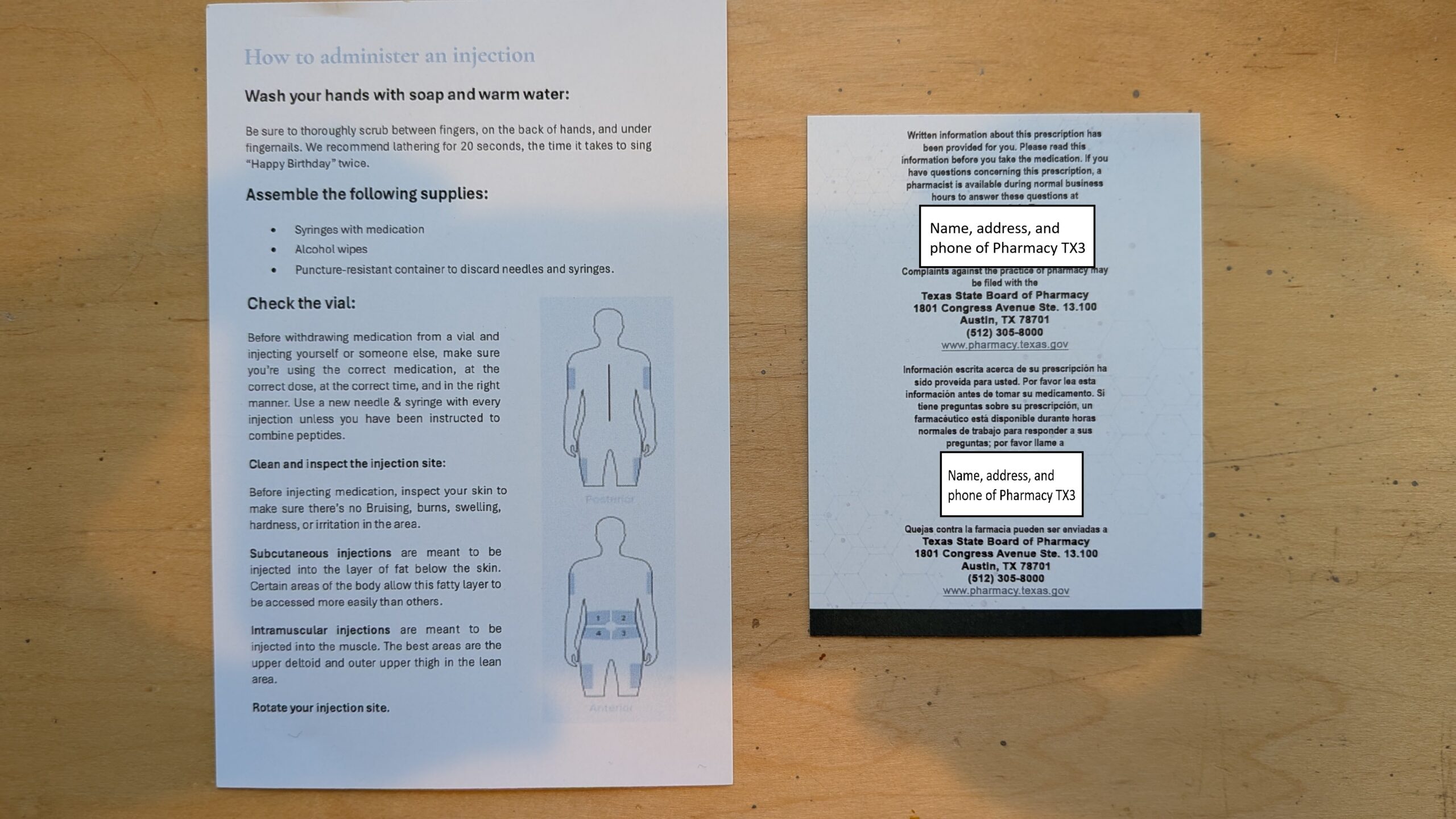
Injection instructions and syringes that accompanied peptide shipments (PSM)

The examples suggest that enforcement is currently so lax that some licensed compounders do not fear repercussions, even when they are compounding medicines in violation of the FDCA.
Some details have been obscured in the pictures below because the products are subject to an active complaint with relevant boards of pharmacy and the FDA’s Office of Criminal Investigation.
BPC-157
At the July PCAC meeting, FDA scientists recommended that BPC-157, a peptide proposed for treating ulcerative colitis, Crohn’s disease, Celiac disease, and tendonitis, remain unavailable for compounding. As of October 16, 2026, it is not legal to compound.
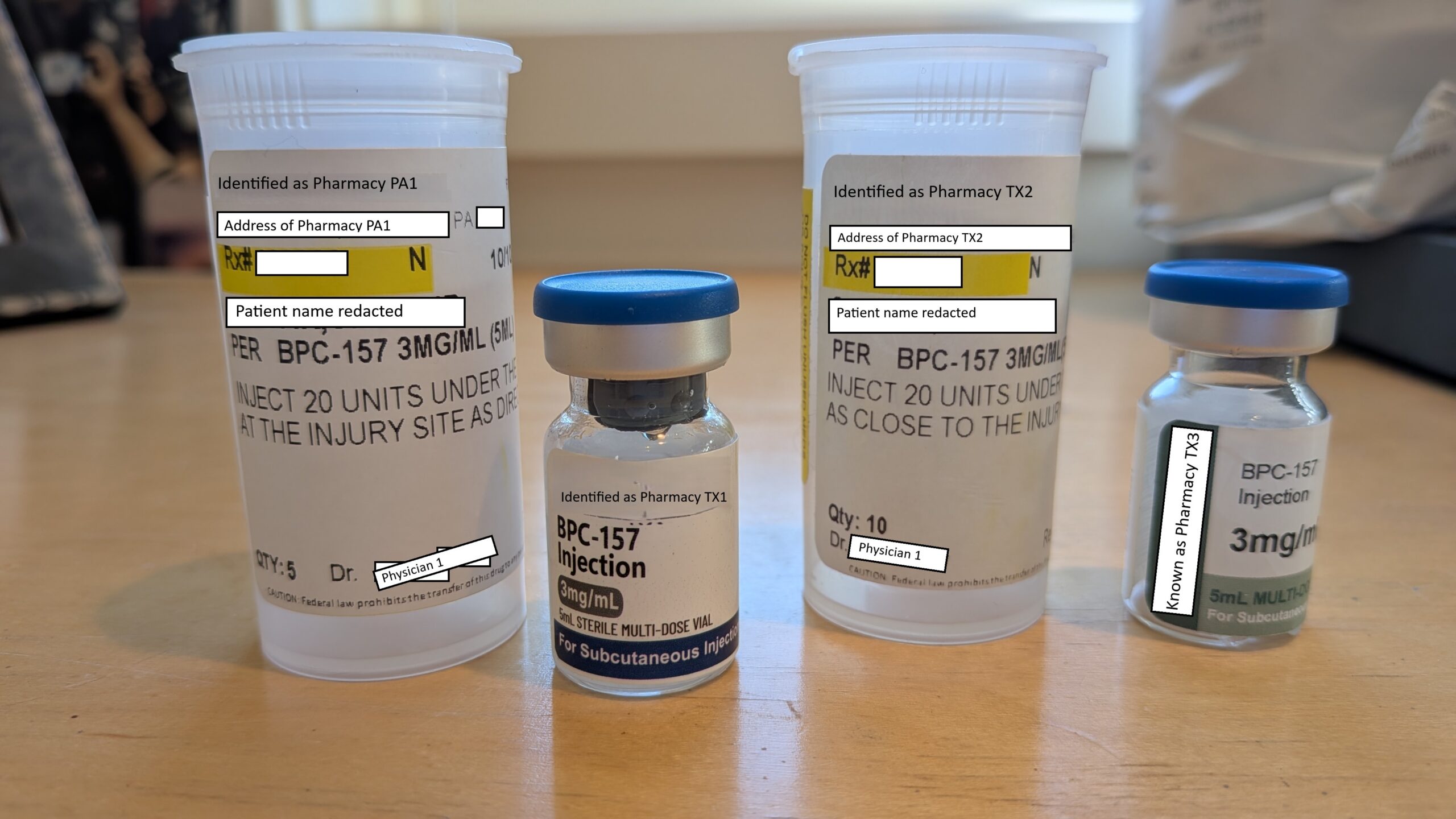
Pharmacy PA1 is licensed in Pennsylvania and possesses a non-resident pharmacy license in California, where this was dispensed by mail. We were unable to find Pharmacy PA1’s California non-resident sterile compounding license.
The vial inside the left sleeve was made by Pharmacy TX1, which is licensed in TX and possesses a community sterile compounding license. It shares a nearly identical address to Pharmacy TX2. We could not find a license for them in California.
The right sleeve was issued by Pharmacy TX2, which shares an almost identical address to Pharmacy TX1. It possesses a Community Pharmacy license with non-sterile compounding permitted. We could not find a license for them in California.
The vial inside the prescribing sleeve is labeled with logos and information from Pharmacy TX3, which is licensed in TX and possesses a community sterile compounding license. We were unable to locate a California license for them.
Physician 1 is licensed in California with a license active through 2028.
GHK-CU
GHK-CU is a peptide that is currently not permitted to compound for injections. It is scheduled to be considered in February at the next PCAC meeting.
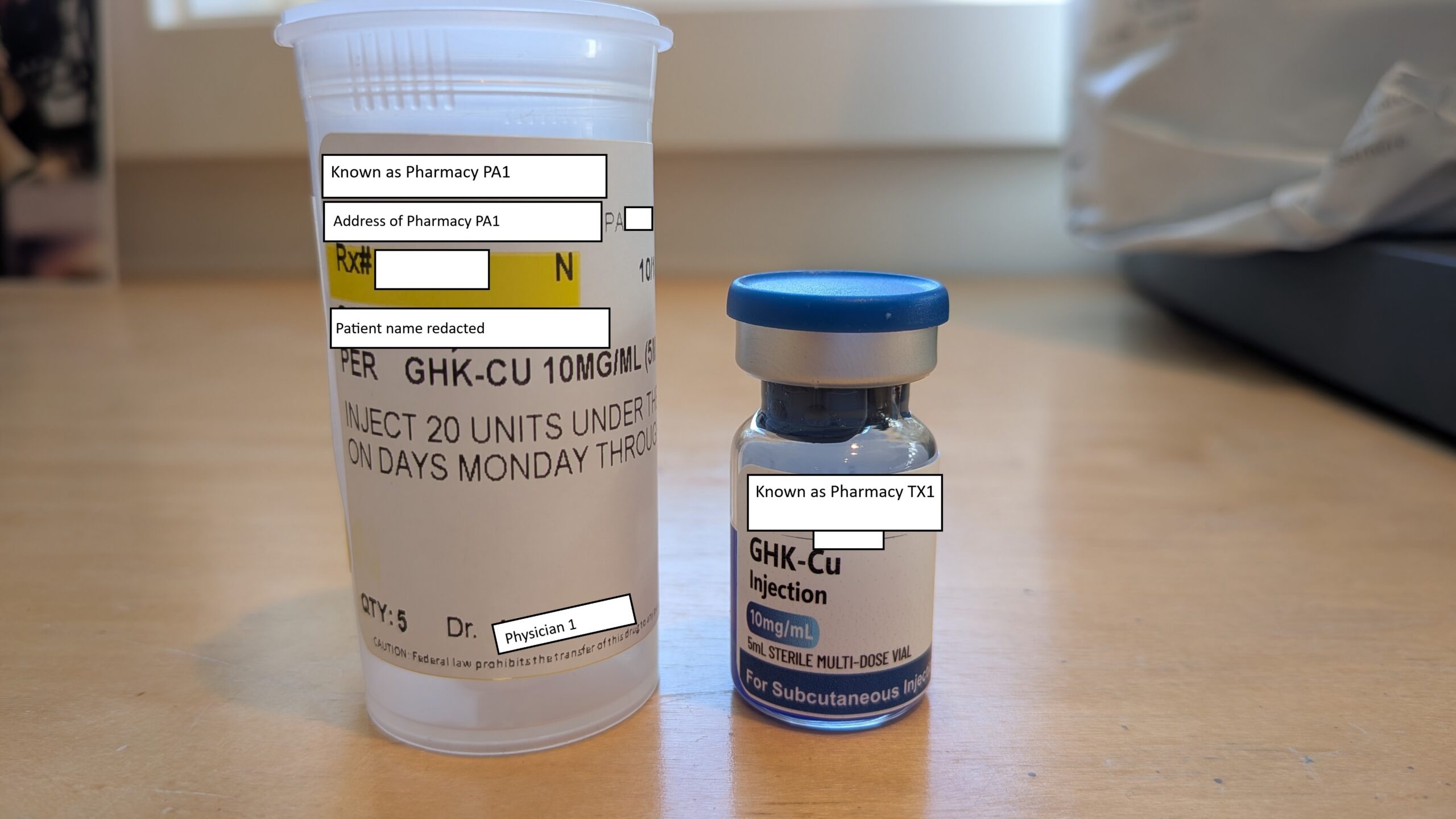
Pharmacy PA1 is licensed in Pennsylvania and possesses a non-resident pharmacy license in California, where this was dispensed by mail. We could not locate a California non-resident sterile compounding license for them.
The vial inside the prescribing sleeve is labeled with logos and information from Pharmacy TX1, which is licensed in TX and possesses a community sterile compounding license. We were unable to locate a California license for them.
Physician 1 is licensed in California with a license active through 2028.
CJC-1295 & Ipamorelin
The FDA has determined that CJC-1295 & ipamorelin are "category 2” bulk drug substances, which may present significant safety risks, including potential immunogenicity, increased heart rate, systemic vasodilatory reaction and death. This designation makes them illegal to compound.
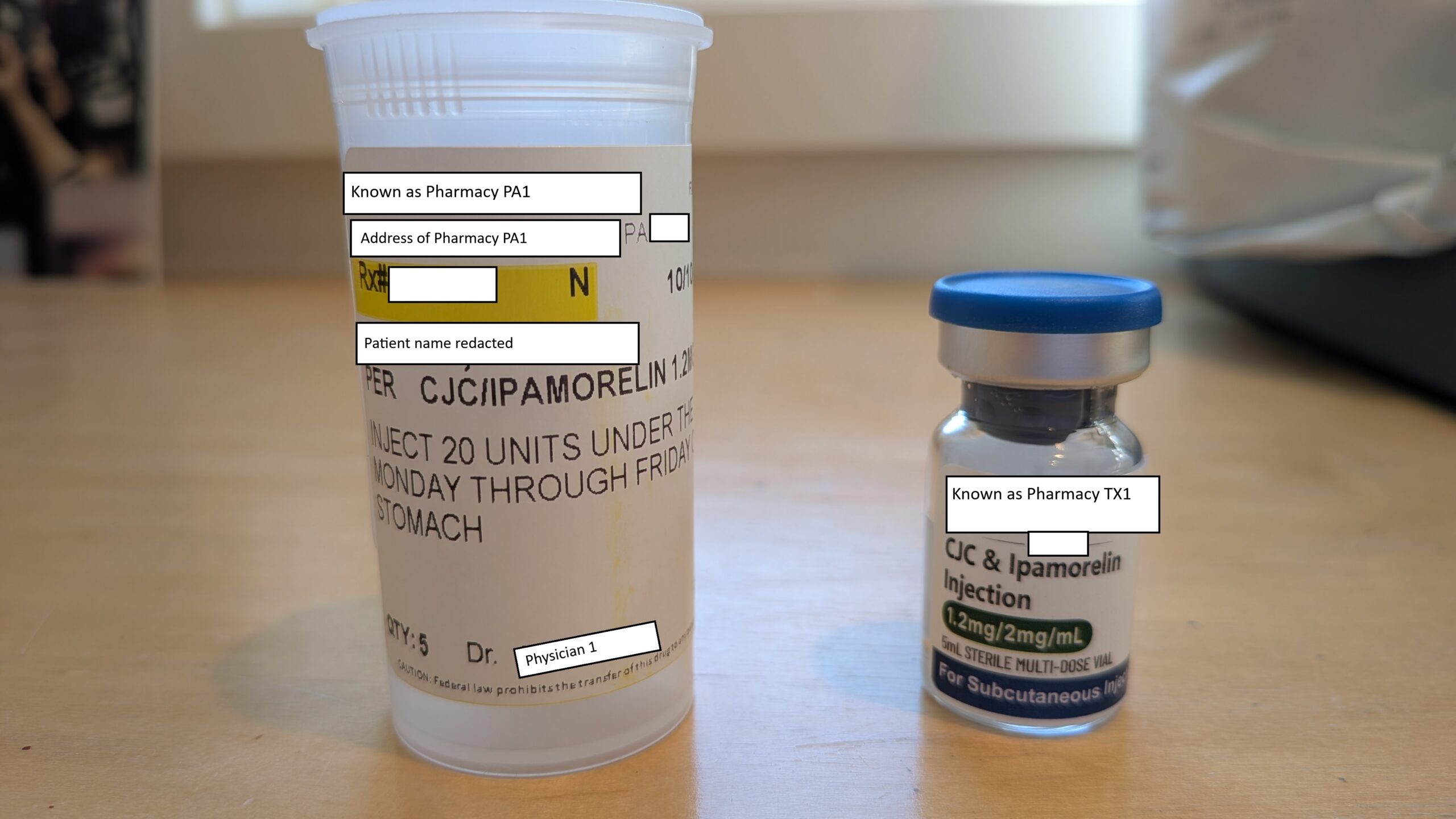
Pharmacy PA1 is licensed in Pennsylvania and possesses a non resident pharmacy license in California, where this was dispensed by mail. We did not find its California non-resident sterile compounding license.
The vial inside the prescribing sleeve is labeled with logos and information from Pharmacy TX1, which is licensed in TX and possesses a community sterile compounding license. We were unable to locate a California license for them.
Physician 1 is licensed in California with a license active through 2028.
MOTS-c
The U.S. Anti-Doping Agency characterizes MOTS-c as a mitochondrial-derived peptide with animal research suggesting that it may protect cells under different stresses. The peptide has not been approved by the FDA for use in humans. At the July PCAC, FDA scientists recommended that MOTS-c remain unavailable for compounding. As of October 16, 2026, it is still illegal to compound.

Pharmacy PA1 is licensed in Pennsylvania and possesses a non-resident pharmacy license in California where this was dispensed by mail. We didn’t find a California non-resident sterile compounding license for them.
The vial inside the prescribing sleeve is labeled with logos and information from Pharmacy TX1, which is licensed in TX and possesses a community sterile compounding license. We were unable to locate a California license for them.
Physician 1 is licensed in California with a license active through 2028.